Reading a Graveyard; Clonfert, Duhallow, Co. Cork
Historic graveyards are compasses in the landscape.
If you're ever lost in the Irish countryside, a graveyard can help you get your bearings.
Historic graveyards are compasses in the landscape.
If you're ever lost in the Irish countryside, a graveyard can help you get your bearings.
Catholics and Protestants are often buried together in Ireland.
Or rather, buried in the same place. The same burial ground.
We sometimes use different roads to get to the graveyard.
We sometimes use difference entrances into the same graveyard.
It's even been said some burial grounds have walls under the ground to stop our bones from mixing. We're a funny old crowd.
Graveyards are made and maintained by the living, as sacred places to the memory of the beloved dead.
And the social history of a parish is wrapped up in it's graveyards.
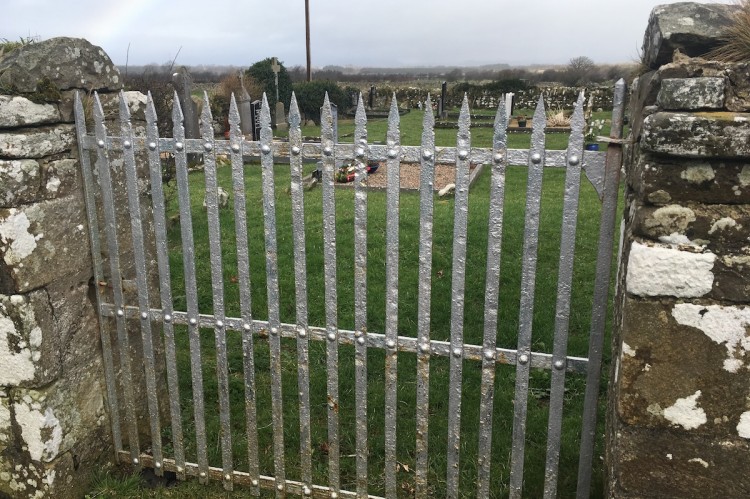
By studying graveyards we can tell who the big landowners were; who had a middling farm and who had none. We can identify the trades families engaged in. And one of the most commonly encountered trades is that of blacksmith. For graveyards, blacksmith's made iron crosses, grave surrounds, and put together grave railings. But mainly blacksmiths made the iron gates that close-off the sacred space.
Cork is a corrugated county, east-west valleys and ridges are key features of the landscape.
Cork people are always at the bottom of a hill or going up a hill. It has been said that our accents are forged by that fact - the Cork accent has a sing-song rythym, I'm going up and now I'm going down.
On the old Carlow town to Baltinglass road is a small, overgrown graveyard. It bears the name Knockaunarelic - the small hill of the graveyard - and it is located in the townland of Pollerton Little. I thought Pollerton was going to be a local landlord's name but it is in fact related to the limestone solid geology beneath - sinkholes giving the name 'townland of the holey ground - Baile Pholaird Beag'.
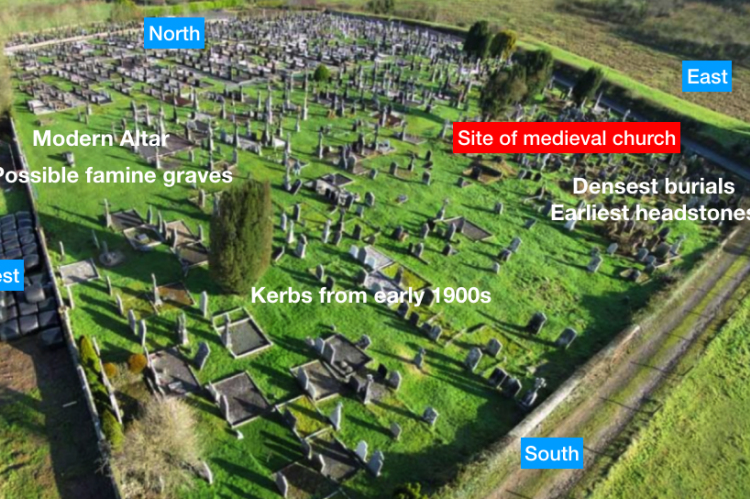
Old KIlcummin is three graveyards in one. A core medieval churchyard has morphed into a modern cemetery (kerbs and imported polished marble), and a nineteenth century graveyard (with high, and ground, vaulted tombs) and it is more than twice the width of the average graveyard. Three in one.
Names stand out in Lissonuffy graveyard in Co. Roscommon. The Duffys are here a long time and it is they who give the place it's current name. There are Brennan's here too, they and the Duffy's were the Gaelic Lords of this place. Carlos you'll see hardly anywhere else in Ireland but they are old stock under Slieve Bán in mid-Roscommon.
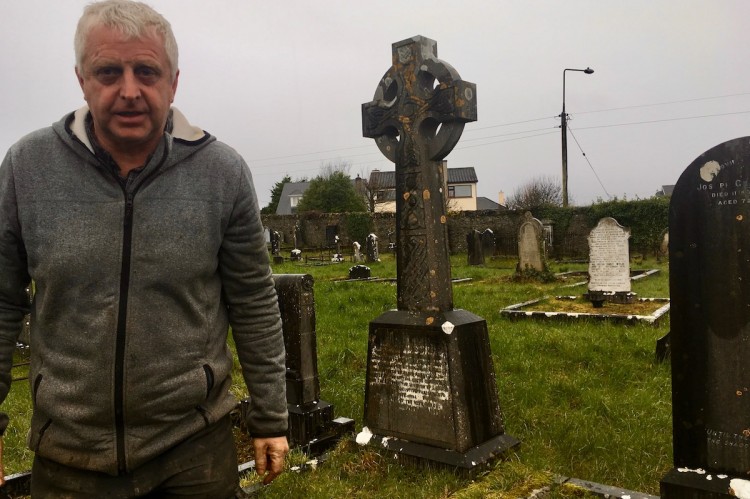
Paddy Joe Gallagher is the caretaker of Keelogues graveyard in N Sligo. As a community survey team recorded the headstones in Keelogues graveyard Paddy Joe led us around saying who was buried where and when! Throughout the drizzley morning he remembered each funeral and the order of burial and in the afternoon I saw him refer to a blue notebook for some extra detail.
In archaeology we have the concept of taphonomy. Taphonomy tells us that the ruins of the past looked very different when they were lived in. A castle would have been plastered and painted. Interior walls would be lined, painted and covered in thick drapes (think of poor old Polonius getting stabbed in the arras (always got a laugh in school)). Picture a ruined church with whitewashed walls and fresh golden thatch.
We average 5 km of daily walking when surveying historic graveyards.
Yesterday the graveyard in Drucliffe was bigger than usual and we covered 7.5 km. That is 7.5km of walking beneath Benbulben -when every time you look up from the ground the beauty of Co. Sligo is there in its intriguing glory. We've done graveyard projects all over Ireland and from Dorset to Aberdeen and Benbulben is one of the most striking locations around.