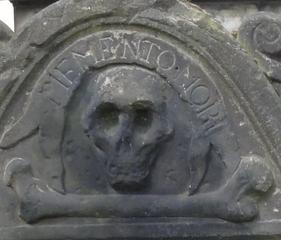
 John Tierney of Historic Graves on a recent trip to Edinburgh in Scotalnd to talk at the Digital Futures Conference took the accompanying photograph in the graveyard known as the Kirk of Canongate. Memento Mori are reminders of our mortality. They have come back into vogue recently and can be used to nudge people towards better behaviour. This idea of gentle persuasion or nudging has been developed by Thaler and Sunstein in their seminal popular psychology book called ‘Nudge’. They developed methods to encourage people towards better decisions and their methods have been taken on board by health agencies and other government bodies in the United States. Memento Mori can act in this fashion, as tacit acknowledgements or reminders of our mortality seem to propel people to action or generate renewed enthusiasm. They can instil a kind of ‘carpe diem’ or ‘seize the day’ attitude. It has become popular therefore to place reproduction skulls on desks or have images of skulls on computer desktops.
Memento Mori have a long tradition dating back to classical times when triumphant generals were encouraged to remember their mortality and that while they may have been victorius today who knows what tomorrow will bring. The legends of ‘The Dance of Death’ or the ‘Danse Macabre’ and the ‘Three Living and the Three Dead’ originated in Europe during the Middle Ages, after the black death in the fourteenth century. Memnto Mori symbols were used in European art and literature from this period.
 The use of these symbols of mortality on memorial monuments became popular in Europe during the fifteenth and sixteenth centuries and appears in Ireland at the end of the sixteenth century. A skull with a longbone in its mouth is depicted on the McGrath chest tomb in Lismore Co. Waterford which dates to 1557.
 McCormick believes that this particular group of head stones owe their origin not to the sixteenth and seventeenth century sepulchral monuments found in the south of Ireland but are instead derived from Scotish Jacobean monuments of the same period and which are largely confined to Scotish towns such as Edinburgh and Stirling.