Douro cemetery tour July 2025
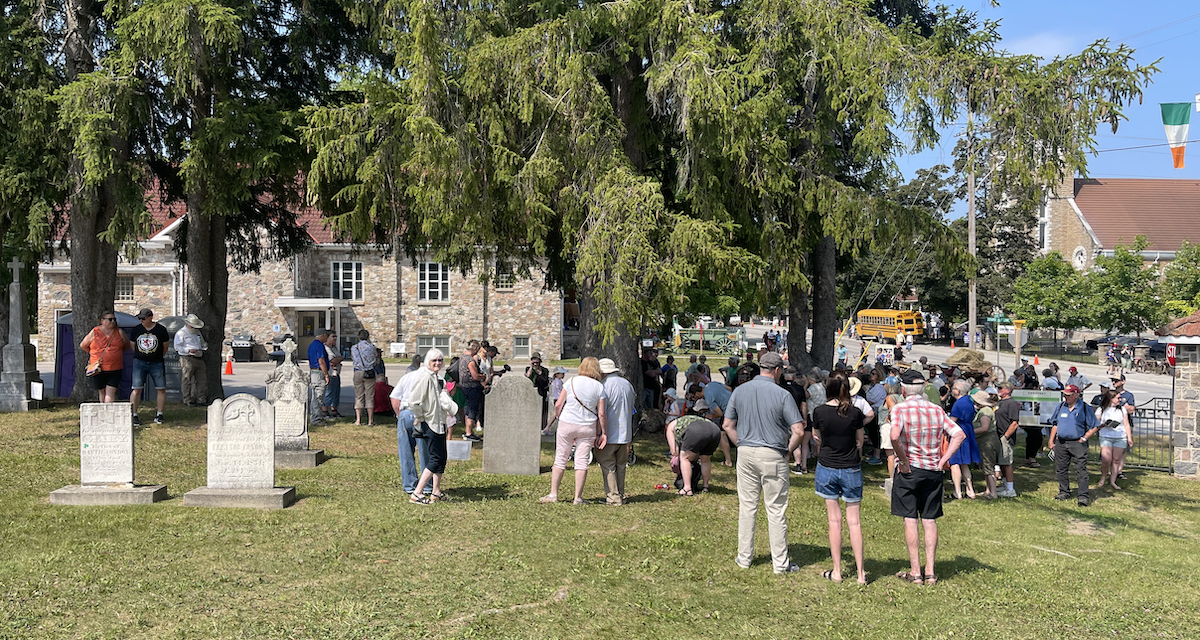
This is the script of a talk given by John Tierney on Sunday 6th July 2025 , in Douro village, Ontario as part of the Douro 200th Anniversary of the Peter Robinson Settement which brought around 500 Irish families from southern Ireland to northern Ontario. Those families put down deep roots in the area while also spreading across the rest of the continent. John was invited by the Douro 200th Anniversary committee to attend, survey their local cemeteries, and give this talk. The RIA 2024/5 Commemorations Bursary kindly funded the trip and the resulting surveys.
__________________________________________________________________________
Douro_2025_Presentation_RIA_JT.pdf
Intro
I'm John Tierney, an archaeologist originally from Cork, Ireland, and I'm here thanks to funding from the Royal Irish Academy to study the Peter Robinson settlers. This Canadian settlement represents one of the most important diaspora case studies globally because of its extraordinary documentation. Every person on those ships was named and aged, and your community has traced many through family histories, creating an invaluable record of how cultural mixing occurs in diaspora communities.
Tracing Families
In Ireland, there's a deeply embedded cultural practice we call "tracing your people." In every extended family of perhaps 100 members, only two or three become the designated tracers, and the process is self selecting. These are the people who remember what mammy said, what granddad said, what granny said. They're the ones who, when given a box of photographs, examine every single one, and when handed a box of letters, read every single letter repeatedly. The other 95% of the family relies on these specialists when they need genealogical information. I'm a trained archaeologist but not a natural tracer, while my wife, also an archaeologist, is a tracer who can clearly remember family stories her mother told when she was a young girl.
The Historic Graves Project
This practice led to our Historic Graves project, which started in 2009. Working with colleague Maurizio Toscano, we built www.historicgraves.com as a national database. Our team of four people has surveyed nearly 1,000 of Ireland's 3,000 graveyards. The work is driven by community volunteers who respond to our calls for help. Since 2014, in association with Ballyhoura Rural Development CLG, we've deliberately targeted Peter Robinson ancestral regions, completing 90% of County Limerick, 70% of County Cork, and significant portions of Waterford and Tipperary.
Why did families choose to emigrate in the 1820s?
To understand why people left Ireland in the 1820s, we need to examine a 400-year framework. From 1560 to 1660, Ireland experienced Tudor conquest involving what historians now call "total warfare" and partial genocide. By 1800, the rural Irish Catholic population had recovered to 6 million, largely due to what can be called 'the potato revolution'. Regardless of propoerty size, sufficient potatoes enabled survival and population growth. At the time Irish landholdings were split among sons, creating unsustainable small farms. By the 1820s, farm sizes had often become too small to feed families, and the opportunity to emigrate arose. This was part of early globalization.
The Geography of Irish Graveyards
Irish graveyards follow a specific physical layout that differs markedly from Canadian cemeteries. They typically contain a church, often ruined, oriented east-west with burials south of the church. Headstones face east because bodies are buried with heads west, symbolically "facing east." The graves are organized in north-south running rows, creating highly organized spaces designed to accommodate the maximum number of burials.
Surveying Irish Graveyards
Our survey technique is systematic and community-driven. We start in the southwest corner, placing numbered masking tape on each headstone, which takes about two hours. We then photograph all headstones with GPS enabled, taking another two hours. Finally, we transcribe all text from each headstone and digitize it for our public database. The most effective tool for reading headstones is a small mirror to reflect light onto stone surfaces, supplemented by a brush and water on flat surfaces. Irish headstones follow standard formulas like "Here lies the body of," "Erected by," and "In loving memory of," so once you learn the patterns, you can read any headstone efficiently.
Irish graveyards contain various monument types. Beyond standard headstones at the head of graves and footstones at the foot, there are side stones marking grave boundaries, body slabs lying flat on the ground, table tombs raised on legs, and box tombs raised on box bases. Particularly significant are field stones used by the laborer class who couldn't afford carved headstones. These families would take stones from home, shape them distinctively, and place them to mark family graves. For example, everyone in a small community knew that the Caseys had the pointy-headed stone down alongside the oak tree.
Reading Headstones & Following the Clues
Surname and place name analysis reveals critical information that genealogical researchers often overlook. Spelling variations aren't always just misspellings but indicate specific regional origins. Sheahan versus Sheehan represents different geographic origins, and when you encounter someone named Cornelius Sheahan, this specific spelling and name combination points directly to North Cork and West Limerick. We use specialized resources including logainm.ie and townlands.ie for place names, swilson.info and johngrenham.com for surnames, and nationalarchives.ie for census data from 1901 and 1911.
The Current Douro Survey
We've recently integrated AI technology that now transcribes handwritten notes into spreadsheets and extracts information from headstone photographs with 90% accuracy. We're developing an app for community use that we have successfully tested this week in Douro cemetery. We also analyze surname frequency patterns to create "fingerprints" of communities. Irish accents change every 10 miles (roughly), and surname combinations create similar geographic fingerprints. Our analysis of Douro cemetery shows Sheehans, O'Briens, Leahys, Condons, and Sullivans as dominant surnames.
The material differences between Irish and Canadian headstones tell their own story. In Ireland, 90% of historic headstones are limestone, while in Douro, 90% are marble, reflecting the different materials available in the new continent. Marble only appeared in Ireland around 1880-1890 for wealthier families. What we see in Canadian cemeteries represents "Irish surnames carved on Canadian stone," a marriage of Irish cultural practices with local North American materials and techniques.
The Peter Robinson settlement provides exceptional documentation that allows us to understand how cultural mixing occurs in diaspora communities. By studying how your (the Peter Robinson Settlement descendants) cultural integration happened, we can better understand contemporary global migration patterns and learn effective approaches for diverse communities living as neighbours. This research demonstrates how graveyards serve as crucial historical documents, preserving not just individual stories but broader patterns of migration, cultural adaptation, and community formation.